#include <ultra_circuit_builder.hpp>
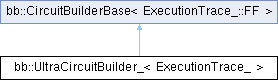
Classes | |
| struct | cached_partial_non_native_field_multiplication |
| Used to store instructions to create partial_non_native_field_multiplication gates. More... | |
| struct | RangeList |
Public Types | |
| enum | MEMORY_SELECTORS { MEM_NONE , RAM_CONSISTENCY_CHECK , ROM_CONSISTENCY_CHECK , RAM_TIMESTAMP_CHECK , ROM_READ , RAM_READ , RAM_WRITE } |
| enum | NNF_SELECTORS { NNF_NONE , LIMB_ACCUMULATE_1 , LIMB_ACCUMULATE_2 , NON_NATIVE_FIELD_1 , NON_NATIVE_FIELD_2 , NON_NATIVE_FIELD_3 } |
| using | ExecutionTrace = ExecutionTrace_ |
| using | FF = typename ExecutionTrace::FF |
| using | RomRamLogic = RomRamLogic_< ExecutionTrace > |
| using | scaled_witness = std::pair< uint32_t, FF > |
| using | add_simple = std::tuple< scaled_witness, scaled_witness, FF > |
 Public Types inherited from bb::CircuitBuilderBase< ExecutionTrace_::FF > Public Types inherited from bb::CircuitBuilderBase< ExecutionTrace_::FF > | |
| using | FF = ExecutionTrace_::FF |
| using | EmbeddedCurve = curve::Grumpkin |
Public Member Functions | |
| void | populate_public_inputs_block () |
| Copy the public input idx data into the public inputs trace block. | |
| void | process_non_native_field_multiplications () |
| Iterates over the cached_non_native_field_multiplication objects, removes duplicates, and instantiates the corresponding constraints. | |
| UltraCircuitBuilder_ (const size_t size_hint=0, bool is_write_vk_mode=false) | |
| UltraCircuitBuilder_ (const size_t size_hint, const std::vector< FF > &witness_values, const std::vector< uint32_t > &public_inputs, const bool is_write_vk_mode) | |
| Constructor from data generated from ACIR. | |
| UltraCircuitBuilder_ (const UltraCircuitBuilder_ &other)=default | |
| UltraCircuitBuilder_ (UltraCircuitBuilder_ &&other)=default | |
| UltraCircuitBuilder_ & | operator= (const UltraCircuitBuilder_ &other)=default |
| UltraCircuitBuilder_ & | operator= (UltraCircuitBuilder_ &&other)=default |
| ~UltraCircuitBuilder_ () override=default | |
| void | check_selector_length_consistency () |
| Debug helper method for ensuring all selectors have the same size. | |
| void | finalize_circuit (const bool ensure_nonzero) |
| void | add_gates_to_ensure_all_polys_are_non_zero () |
| Ensure all polynomials have at least one non-zero coefficient to avoid commiting to the zero-polynomial. | |
| void | create_add_gate (const add_triple_< FF > &in) |
| Create an addition gate, where in.a * in.a_scaling + in.b * in.b_scaling + in.c * in.c_scaling + in.const_scaling = 0. | |
| void | create_big_mul_add_gate (const mul_quad_< FF > &in, const bool use_next_gate_w_4=false) |
| Create a big multiplication-addition gate, where in.a * in.b * in.mul_scaling + in.a * in.a_scaling + in.b * in.b_scaling + in.c * in.c_scaling + in.d * in.d_scaling + in.const_scaling = 0. If include_next_gate_w_4 is enabled, then this sum also adds the value of the 4-th witness at the next index. | |
| void | create_big_add_gate (const add_quad_< FF > &in, const bool use_next_gate_w_4=false) |
| Create a big addition gate, where in.a * in.a_scaling + in.b * in.b_scaling + in.c * in.c_scaling + in.d * in.d_scaling + in.const_scaling = 0. If include_next_gate_w_4 is enabled, then the sum also adds the value of the 4-th witness at the next index. | |
| void | create_bool_gate (const uint32_t a) |
| Generate an arithmetic gate equivalent to x^2 - x = 0, which forces x to be 0 or 1. | |
| void | create_arithmetic_gate (const arithmetic_triple_< FF > &in) |
| A plonk gate with disabled (set to zero) fourth wire. q_m * a * b + q_1 * a + q_2 * b + q_3. | |
| void | create_ecc_add_gate (const ecc_add_gate_< FF > &in) |
| Create an elliptic curve addition gate. | |
| void | create_ecc_dbl_gate (const ecc_dbl_gate_< FF > &in) |
| Create an elliptic curve doubling gate. | |
| void | fix_witness (const uint32_t witness_index, const FF &witness_value) |
| Add a gate equating a particular witness to a constant, fixing its value. | |
| void | create_new_range_constraint (const uint32_t variable_index, const uint64_t target_range, std::string const msg="create_new_range_constraint") |
| Constrain a variable to a range. | |
| void | create_range_constraint (const uint32_t variable_index, const size_t num_bits, std::string const &msg) |
| uint32_t | put_constant_variable (const FF &variable) |
| size_t | get_num_constant_gates () const override |
| size_t | get_num_finalized_gates () const override |
| Get the number of gates in a finalized circuit. | |
| size_t | get_num_finalized_gates_inefficient (bool ensure_nonzero=true) const |
| Get the number of gates in the finalized version of the circuit. | |
| size_t | get_tables_size () const |
| Get combined size of all tables used in circuit. | |
| size_t | get_finalized_total_circuit_size () const |
| Get the actual finalized size of a circuit. Assumes the circuit is finalized already. | |
| void | assert_equal_constant (const uint32_t a_idx, const FF &b, std::string const &msg="assert equal constant") |
| plookup::BasicTable & | get_table (const plookup::BasicTableId id) |
| Get the basic table with provided ID from the set of tables for the present circuit; create it if it doesnt yet exist. | |
| plookup::MultiTable & | get_multitable (const plookup::MultiTableId id) |
| const std::deque< plookup::BasicTable > & | get_lookup_tables () const |
| std::deque< plookup::BasicTable > & | get_lookup_tables () |
| size_t | get_num_lookup_tables () const |
| plookup::ReadData< uint32_t > | create_gates_from_plookup_accumulators (const plookup::MultiTableId &id, const plookup::ReadData< FF > &read_values, const uint32_t key_a_index, std::optional< uint32_t > key_b_index=std::nullopt) |
| Create gates from pre-computed accumulator values which simultaneously establish individual basic-table lookups and the reconstruction of the desired result from those components. | |
| std::vector< uint32_t > | decompose_into_default_range (const uint32_t variable_index, const uint64_t num_bits, const uint64_t target_range_bitnum=DEFAULT_PLOOKUP_RANGE_BITNUM, std::string const &msg="decompose_into_default_range") |
| void | create_unconstrained_gate (auto &block, const uint32_t &idx_1, const uint32_t &idx_2, const uint32_t &idx_3, const uint32_t &idx_4) |
| Create a gate with no constraints but with possibly non-trivial wire values. | |
| void | create_unconstrained_gates (const std::vector< uint32_t > &variable_index) |
| void | create_sort_constraint (const std::vector< uint32_t > &variable_index) |
| void | create_sort_constraint_with_edges (const std::vector< uint32_t > &variable_index, const FF &, const FF &) |
| void | assign_tag (const uint32_t variable_index, const uint32_t tag) |
| void | set_tau_at_index (const uint32_t tag_index, const uint32_t tau_index) |
| Set the tau(tag_index) = tau_index. | |
| void | set_tau_transposition (const uint32_t tag_index_1, const uint32_t tag_index_2) |
| Add a transposition to tau. | |
| uint32_t | get_new_tag () |
| RangeList | create_range_list (const uint64_t target_range) |
| void | process_range_list (RangeList &list) |
| void | process_range_lists () |
| void | apply_memory_selectors (const MEMORY_SELECTORS type) |
| Enable the memory gate of particular type. | |
| void | apply_nnf_selectors (const NNF_SELECTORS type) |
| Enable the nnf gate of particular type. | |
| void | range_constrain_two_limbs (const uint32_t lo_idx, const uint32_t hi_idx, const size_t lo_limb_bits=DEFAULT_NON_NATIVE_FIELD_LIMB_BITS, const size_t hi_limb_bits=DEFAULT_NON_NATIVE_FIELD_LIMB_BITS, std::string const &msg="range_constrain_two_limbs") |
| std::array< uint32_t, 2 > | evaluate_non_native_field_multiplication (const non_native_multiplication_witnesses< FF > &input) |
| Create gates for a full non-native field multiplication identity a * b = q * p + r. | |
| std::array< uint32_t, 2 > | queue_partial_non_native_field_multiplication (const non_native_partial_multiplication_witnesses< FF > &input) |
| Queue the addition of gates constraining the limb-multiplication part of a non native field mul. | |
| std::array< uint32_t, 5 > | evaluate_non_native_field_subtraction (add_simple limb0, add_simple limb1, add_simple limb2, add_simple limb3, std::tuple< uint32_t, uint32_t, FF > limbp) |
| Construct gates for non-native field subtraction. | |
| std::array< uint32_t, 5 > | evaluate_non_native_field_addition (add_simple limb0, add_simple limb1, add_simple limb2, add_simple limb3, std::tuple< uint32_t, uint32_t, FF > limbp) |
| Construct gates for non-native field addition. | |
| size_t | create_ROM_array (const size_t array_size) |
| Create a new read-only memory region (a.k.a. ROM table) | |
| void | set_ROM_element (const size_t rom_id, const size_t index_value, const uint32_t value_witness) |
Initialize a rom cell to equal value_witness | |
| void | set_ROM_element_pair (const size_t rom_id, const size_t index_value, const std::array< uint32_t, 2 > &value_witnesses) |
| Initialize a ROM array element with a pair of witness values. | |
| uint32_t | read_ROM_array (const size_t rom_id, const uint32_t index_witness) |
| Read a single element from ROM. | |
| std::array< uint32_t, 2 > | read_ROM_array_pair (const size_t rom_id, const uint32_t index_witness) |
| Read a pair of elements from ROM. | |
| size_t | create_RAM_array (const size_t array_size) |
| Create a new updatable memory region. | |
| void | init_RAM_element (const size_t ram_id, const size_t index_value, const uint32_t value_witness) |
Initialize a RAM cell to equal value_witness | |
| uint32_t | read_RAM_array (const size_t ram_id, const uint32_t index_witness) |
| void | write_RAM_array (const size_t ram_id, const uint32_t index_witness, const uint32_t value_witness) |
| void | create_poseidon2_external_gate (const poseidon2_external_gate_< FF > &in) |
| Poseidon2 external round gate, activates the q_poseidon2_external selector and relation. | |
| void | create_poseidon2_internal_gate (const poseidon2_internal_gate_< FF > &in) |
| Poseidon2 internal round gate, activates the q_poseidon2_internal selector and relation. | |
| const std::vector< uint32_t > & | get_used_witnesses () const |
| const std::unordered_set< uint32_t > & | get_finalize_witnesses () const |
| void | update_used_witnesses (uint32_t var_idx) |
| Add a witness index to the boomerang exclusion list. | |
| void | update_used_witnesses (const std::vector< uint32_t > &used_indices) |
| Add a list of witness indices to the boomerang exclusion list. | |
| void | update_finalize_witnesses (uint32_t var_idx) |
| Add a witness index to the finalize exclusion list. | |
| void | update_finalize_witnesses (const std::vector< uint32_t > &finalize_indices) |
| Add a list of witness indices to the finalize exclusion list. | |
| msgpack::sbuffer | export_circuit () override |
| Public Member Functions inherited from bb::CircuitBuilderBase< ExecutionTrace_::FF > | |
| CircuitBuilderBase (size_t size_hint=0, bool is_write_vk_mode=false) | |
| CircuitBuilderBase (const CircuitBuilderBase &other)=default | |
| CircuitBuilderBase (CircuitBuilderBase &&other) noexcept=default | |
| CircuitBuilderBase & | operator= (const CircuitBuilderBase &other)=default |
| CircuitBuilderBase & | operator= (CircuitBuilderBase &&other) noexcept=default |
| virtual | ~CircuitBuilderBase ()=default |
| bool | operator== (const CircuitBuilderBase &other) const=default |
| virtual size_t | get_num_variables () const |
| size_t | num_gates () const |
| void | increment_num_gates (size_t count=1) |
| const std::unordered_map< uint32_t, uint32_t > & | tau () const |
| uint32_t | zero_idx () const |
| const std::vector< FF > & | get_variables () const |
| FF | get_variable (const uint32_t index) const |
| Get the value of the variable v_{index}. | |
| void | set_variable (const uint32_t index, const FF &value) |
| Set the value of the variable pointed to by a witness index. | |
| const std::vector< uint32_t > & | public_inputs () const |
| void | finalize_public_inputs () |
| Set the _public_inputs_finalized to true to prevent any new public inputs from being added. | |
| void | initialize_public_inputs (const std::vector< uint32_t > &public_inputs) |
| Directly initialize the public inputs vector. | |
| virtual uint32_t | add_variable (const FF &in) |
| Add a variable to variables. | |
| uint32_t | add_variable (const OT &in)=delete |
| virtual uint32_t | add_public_variable (const FF &in) |
| Add a public variable to variables. | |
| uint32_t | add_public_variable (const OT &in)=delete |
| virtual uint32_t | set_public_input (uint32_t witness_index) |
| Make a witness variable public. | |
| virtual void | assert_equal (uint32_t a_idx, uint32_t b_idx, std::string const &msg="assert_equal") |
| size_t | get_circuit_subgroup_size (size_t num_gates) const |
| size_t | num_public_inputs () const |
| virtual void | set_variable_name (uint32_t index, const std::string &name) |
| Assign a name to a variable (equivalence class) | |
| bool | failed () const |
| const std::string & | err () const |
| void | failure (std::string msg) |
| bool | is_write_vk_mode () const |
Public Attributes | |
| ExecutionTrace | blocks |
| std::unordered_map< FF, uint32_t > | constant_variable_indices |
| RomRamLogic | rom_ram_logic |
| std::vector< uint32_t > | memory_read_records |
| std::vector< uint32_t > | memory_write_records |
| std::map< uint64_t, RangeList > | range_lists |
| std::vector< cached_partial_non_native_field_multiplication > | cached_partial_non_native_field_multiplications |
| bool | circuit_finalized = false |
| std::vector< fr > | ipa_proof |
| Public Attributes inherited from bb::CircuitBuilderBase< ExecutionTrace_::FF > | |
| std::vector< uint32_t > | real_variable_index |
| Map from witness index to real variable index. | |
| std::vector< uint32_t > | real_variable_tags |
real_variable_tags is the tagging mechanism for the the multiset-equality check. | |
| uint32_t | current_tag |
| PairingPointsTagging | pairing_points_tagging |
| PairingPoints tagging tool, used to ensure that all pairing points created in this circuit are aggregated together. This is not related to circuit logic. | |
Static Public Attributes | |
| static constexpr size_t | NUM_WIRES = ExecutionTrace::NUM_WIRES |
| static constexpr std::string_view | NAME_STRING = "UltraCircuitBuilder" |
| static constexpr size_t | DEFAULT_PLOOKUP_RANGE_BITNUM = 14 |
| static constexpr size_t | DEFAULT_PLOOKUP_RANGE_STEP_SIZE = 3 |
| static constexpr size_t | DEFAULT_PLOOKUP_RANGE_SIZE = (1 << DEFAULT_PLOOKUP_RANGE_BITNUM) - 1 |
| static constexpr size_t | DEFAULT_NON_NATIVE_FIELD_LIMB_BITS = 68 |
Private Attributes | |
| std::deque< plookup::BasicTable > | lookup_tables |
| std::vector< uint32_t > | used_witnesses |
| std::unordered_set< uint32_t > | finalize_witnesses |
Additional Inherited Members | |
| Protected Member Functions inherited from bb::CircuitBuilderBase< ExecutionTrace_::FF > | |
| void | set_zero_idx (uint32_t value) |
| uint32_t | get_first_variable_in_class (uint32_t index) const |
| Get the index of the first variable in class. | |
| void | assert_valid_variables (const std::vector< uint32_t > &variable_indices) |
| Check whether each variable index points to a witness value in the variables array. | |
| Protected Attributes inherited from bb::CircuitBuilderBase< ExecutionTrace_::FF > | |
| std::unordered_map< uint32_t, uint32_t > | _tau |
| The permutation on variable tags, as a constituent of the generalized permutation argument. | |
| std::unordered_map< uint32_t, std::string > | variable_names |
Detailed Description
class bb::UltraCircuitBuilder_< ExecutionTrace_ >
Definition at line 41 of file ultra_circuit_builder.hpp.
Member Typedef Documentation
◆ add_simple
| using bb::UltraCircuitBuilder_< ExecutionTrace_ >::add_simple = std::tuple<scaled_witness, scaled_witness, FF> |
Definition at line 527 of file ultra_circuit_builder.hpp.
◆ ExecutionTrace
| using bb::UltraCircuitBuilder_< ExecutionTrace_ >::ExecutionTrace = ExecutionTrace_ |
Definition at line 43 of file ultra_circuit_builder.hpp.
◆ FF
| using bb::UltraCircuitBuilder_< ExecutionTrace_ >::FF = typename ExecutionTrace::FF |
Definition at line 44 of file ultra_circuit_builder.hpp.
◆ RomRamLogic
| using bb::UltraCircuitBuilder_< ExecutionTrace_ >::RomRamLogic = RomRamLogic_<ExecutionTrace> |
Definition at line 45 of file ultra_circuit_builder.hpp.
◆ scaled_witness
| using bb::UltraCircuitBuilder_< ExecutionTrace_ >::scaled_witness = std::pair<uint32_t, FF> |
Definition at line 526 of file ultra_circuit_builder.hpp.
Member Enumeration Documentation
◆ MEMORY_SELECTORS
| enum bb::UltraCircuitBuilder_::MEMORY_SELECTORS |
| Enumerator | |
|---|---|
| MEM_NONE | |
| RAM_CONSISTENCY_CHECK | |
| ROM_CONSISTENCY_CHECK | |
| RAM_TIMESTAMP_CHECK | |
| ROM_READ | |
| RAM_READ | |
| RAM_WRITE | |
Definition at line 58 of file ultra_circuit_builder.hpp.
◆ NNF_SELECTORS
| enum bb::UltraCircuitBuilder_::NNF_SELECTORS |
| Enumerator | |
|---|---|
| NNF_NONE | |
| LIMB_ACCUMULATE_1 | |
| LIMB_ACCUMULATE_2 | |
| NON_NATIVE_FIELD_1 | |
| NON_NATIVE_FIELD_2 | |
| NON_NATIVE_FIELD_3 | |
Definition at line 68 of file ultra_circuit_builder.hpp.
Constructor & Destructor Documentation
◆ UltraCircuitBuilder_() [1/4]
|
inline |
Definition at line 214 of file ultra_circuit_builder.hpp.
◆ UltraCircuitBuilder_() [2/4]
|
inline |
Constructor from data generated from ACIR.
- Parameters
-
size_hint witness_values witnesses values known to acir public_inputs indices of public inputs in witness array is_write_vk_mode true if the builder is use to generate the vk of a circuit
- Note
- witness_values is the vector of witness values known at the time of acir generation. It is filled with witness values which are interleaved with zeros when witnesses are optimized away.
- The length of the witness vector is in general less than total number of variables/witnesses that might be present for a circuit generated from acir, since many gates will depend on the details of the bberg implementation (or more generally on the backend used to process acir).
Definition at line 239 of file ultra_circuit_builder.hpp.
◆ UltraCircuitBuilder_() [3/4]
|
default |
◆ UltraCircuitBuilder_() [4/4]
|
default |
◆ ~UltraCircuitBuilder_()
|
overridedefault |
Member Function Documentation
◆ add_gates_to_ensure_all_polys_are_non_zero()
| void bb::UltraCircuitBuilder_< ExecutionTrace >::add_gates_to_ensure_all_polys_are_non_zero | ( | ) |
Ensure all polynomials have at least one non-zero coefficient to avoid commiting to the zero-polynomial.
- Parameters
-
in Structure containing variables and witness selectors
Definition at line 98 of file ultra_circuit_builder.cpp.
◆ apply_memory_selectors()
| void bb::UltraCircuitBuilder_< ExecutionTrace >::apply_memory_selectors | ( | const MEMORY_SELECTORS | type | ) |
Enable the memory gate of particular type.
Custom Gate Selectors
If we have several operations being performed do not require parametrization (if we put each of them into a separate widget they would not require any selectors other than the ones enabling the operation itself, for example q_special*(w_l-2*w_r)), we can group them all into one widget, by using a special selector q_memory for all of them and enabling each in particular, depending on the combination of standard selector values. So you can do: q_memory * (q_1 * q_2 * statement_1 + q_3 * q_4 * statement_2). q_1=q_2=1 would activate statement_1, while q_3=q_4=1 would activate statement_2
Multiple selectors are used to 'switch' memory gates on/off according to the following pattern:
| gate type | q_mem | q_1 | q_2 | q_3 | q_4 | q_m | q_c |
|---|---|---|---|---|---|---|---|
| RAM/ROM access gate | 1 | 1 | 0 | 0 | 0 | 1 | — |
| RAM timestamp check | 1 | 1 | 0 | 0 | 1 | 0 | — |
| ROM consistency check | 1 | 1 | 1 | 0 | 0 | 0 | — |
| RAM consistency check | 1 | 0 | 0 | 1 | 0 | 0 | 0 |
- Parameters
-
type
Definition at line 992 of file ultra_circuit_builder.cpp.
◆ apply_nnf_selectors()
| void bb::UltraCircuitBuilder_< ExecutionTrace >::apply_nnf_selectors | ( | const NNF_SELECTORS | type | ) |
Enable the nnf gate of particular type.
If we have several operations being performed do not require parametrization (if we put each of them into a separate widget they would not require any selectors other than the ones enabling the operation itself, for example q_special*(w_l-2*w_r)), we can group them all into one widget, by using a special selector q_nnf for all of them and enabling each in particular, depending on the combination of standard selector values. So you can do: q_nnf * (q_1 * q_2 * statement_1 + q_3 * q_4 * statement_2). q_1=q_2=1 would activate statement_1, while q_3=q_4=1 would activate statement_2
Multiple selectors are used to 'switch' nnf gates on/off according to the following pattern:
| gate type | q_nnf | q_1 | q_2 | q_3 | q_4 | q_m |
|---|---|---|---|---|---|---|
| Bigfield Limb Accumulation 1 | 1 | 0 | 0 | 1 | 1 | 0 |
| Bigfield Limb Accumulation 2 | 1 | 0 | 0 | 1 | 0 | 1 |
| Bigfield Product 1 | 1 | 0 | 1 | 1 | 0 | 0 |
| Bigfield Product 2 | 1 | 0 | 1 | 0 | 1 | 0 |
| Bigfield Product 3 | 1 | 0 | 1 | 0 | 0 | 1 |
- Parameters
-
type
Definition at line 1114 of file ultra_circuit_builder.cpp.
◆ assert_equal_constant()
|
inline |
Definition at line 397 of file ultra_circuit_builder.hpp.
◆ assign_tag()
|
inline |
Generalized Permutation Methods
Definition at line 463 of file ultra_circuit_builder.hpp.
◆ check_selector_length_consistency()
|
inline |
Debug helper method for ensuring all selectors have the same size.
Each gate construction method manually appends values to the selectors. Failing to update one of the selectors will lead to an unsatisfiable circuit. This method provides a mechanism for ensuring that each selector has been updated as expected. Its logic is only active in debug mode.
Definition at line 270 of file ultra_circuit_builder.hpp.
◆ create_add_gate()
| void bb::UltraCircuitBuilder_< ExecutionTrace >::create_add_gate | ( | const add_triple_< FF > & | in | ) |
Create an addition gate, where in.a * in.a_scaling + in.b * in.b_scaling + in.c * in.c_scaling + in.const_scaling = 0.
Arithmetic selector is set to 1, all other gate selectors are 0. Multiplication selector is set to 0
- Parameters
-
in A structure with variable indexes and selector values for the gate.
Definition at line 241 of file ultra_circuit_builder.cpp.
◆ create_arithmetic_gate()
| void bb::UltraCircuitBuilder_< ExecutionTrace >::create_arithmetic_gate | ( | const arithmetic_triple_< FF > & | in | ) |
A plonk gate with disabled (set to zero) fourth wire. q_m * a * b + q_1 * a + q_2 * b + q_3.
- c + q_const = 0
- Parameters
-
in Structure containing variables and witness selectors
Definition at line 338 of file ultra_circuit_builder.cpp.
◆ create_big_add_gate()
| void bb::UltraCircuitBuilder_< ExecutionTrace >::create_big_add_gate | ( | const add_quad_< FF > & | in, |
| const bool | include_next_gate_w_4 = false |
||
| ) |
Create a big addition gate, where in.a * in.a_scaling + in.b * in.b_scaling + in.c * in.c_scaling + in.d * in.d_scaling + in.const_scaling = 0. If include_next_gate_w_4 is enabled, then the sum also adds the value of the 4-th witness at the next index.
- Parameters
-
in Structure with variable indexes and wire selector values include_next_gate_w_4 Switches on/off the addition of w_4 at the next index
Definition at line 293 of file ultra_circuit_builder.cpp.
◆ create_big_mul_add_gate()
| void bb::UltraCircuitBuilder_< ExecutionTrace >::create_big_mul_add_gate | ( | const mul_quad_< FF > & | in, |
| const bool | include_next_gate_w_4 = false |
||
| ) |
Create a big multiplication-addition gate, where in.a * in.b * in.mul_scaling + in.a * in.a_scaling + in.b * in.b_scaling + in.c * in.c_scaling + in.d * in.d_scaling + in.const_scaling = 0. If include_next_gate_w_4 is enabled, then this sum also adds the value of the 4-th witness at the next index.
- Parameters
-
in Structure with variable indexes and wire selector values include_next_gate_w_4 Switches on/off the addition of w_4 at the next index
Definition at line 264 of file ultra_circuit_builder.cpp.
◆ create_bool_gate()
| void bb::UltraCircuitBuilder_< ExecutionTrace >::create_bool_gate | ( | const uint32_t | variable_index | ) |
Generate an arithmetic gate equivalent to x^2 - x = 0, which forces x to be 0 or 1.
- Parameters
-
variable_index the variable which needs to be constrained
Definition at line 315 of file ultra_circuit_builder.cpp.
◆ create_ecc_add_gate()
| void bb::UltraCircuitBuilder_< ExecutionTrace >::create_ecc_add_gate | ( | const ecc_add_gate_< FF > & | in | ) |
Create an elliptic curve addition gate.
Adds either one or two gates. In general, this method creates two gates with the following structure:
 | q_ecc | w1  | w2  | w3  | w4  |
 |-------|-----|-----|-----|-----|
 |    1  |  -  | x1  | y1  |  -  | --> constrained
 |    0  | x2  | x3  | y3  | y2  | --> "unconstrained" (utilized by previous gate via shifts)
However, if the "output" of the previous gate is equal to the "input" of the current gate, i.e. (x3, y3)_{i-1} == (x1, y1)_i, we can fuse them together by simply setting the selector values of the previous gate {i-1} to q_ecc = 1 and q_1 = sign_coefficient (which in the relation translates to q_sign). We take advantage of this frequently when performing chained additions or doubling operations.
- Parameters
-
in Elliptic curve point addition gate parameters
Definition at line 371 of file ultra_circuit_builder.cpp.
◆ create_ecc_dbl_gate()
| void bb::UltraCircuitBuilder_< ExecutionTrace >::create_ecc_dbl_gate | ( | const ecc_dbl_gate_< FF > & | in | ) |
Create an elliptic curve doubling gate.
Adds either one or two gates. In general, this method creates two gates with the following structure:
 | q_ecc | w1  | w2  | w3  | w4  |
 |-------|-----|-----|-----|-----|
 |    1  |  -  | x1  | y1  |  -  | --> constrained
 |    0  |  -  | x3  | y3  |  -  | --> "unconstrained" (utilized by previous gate via shifts)
However, if the "output" of the previous gate is equal to the "input" of the current gate, i.e. (x3, y3)_{i-1} == (x1, y1)_i, we can fuse them together by simply setting the selector values of the previous gate {i-1} to q_ecc = 1 and q_m = 1 (which in the relation translates to q_is_double = 1). We take advantage of this frequently when performing chained additions or doubling operations.
- Parameters
-
in Elliptic curve point doubling gate parameters
Definition at line 420 of file ultra_circuit_builder.cpp.
◆ create_gates_from_plookup_accumulators()
| plookup::ReadData< uint32_t > bb::UltraCircuitBuilder_< ExecutionTrace >::create_gates_from_plookup_accumulators | ( | const plookup::MultiTableId & | id, |
| const plookup::ReadData< FF > & | read_values, | ||
| const uint32_t | key_a_index, | ||
| std::optional< uint32_t > | key_b_index = std::nullopt |
||
| ) |
Create gates from pre-computed accumulator values which simultaneously establish individual basic-table lookups and the reconstruction of the desired result from those components.
To perform a lookup, we often need to decompose inputs into smaller "limbs", look up each limb in a BasicTable, then reconstruct the result. E.g., to perform a 32-bit XOR, we decompose into 6-bit limbs, look up each limb's XOR in a 6-bit XOR table, then reconstruct the full 32-bit XOR from those.
This method creates a sequence of lookup gates that simultaneously establish (1) the individual BasicTable lookups, and (2) the reconstruction of the final result from the results of the BasicTable lookups. This is done via an accumulator pattern where the wires in each gate store accumulated sums and we use step size coefficients (stored in q_2, q_m, q_c) to extract actual table entries via an expression of the form derived_entry_i = w_i - step_size_i * w_i_shift where w_i is the wire value at the current row, w_i_shift is the wire value at the next row.
The last lookup has zero step size coefficients (q_2 = q_m = q_c = 0) because there's no next accumulator to subtract; its wire values already contain the raw slices.
- Parameters
-
id MultiTable identifier specifying which lookup operation to perform read_values Pre-computed accumulator values and lookup entries from plookup::get_lookup_accumulators key_a_index Witness index for first input; reused in first lookup gate to avoid creating duplicate variables key_b_index Optional witness index for second input (2-to-1 lookups); reused in first lookup if provided
- Returns
- ReadData<uint32_t> containing witness indices for all created gates. Primary use: [C3][0] contains the result of the lookup operation. All indices are returned (not just the result) because some algorithms like SHA256 need access to the intermediate decomposed limb values.
Definition at line 536 of file ultra_circuit_builder.cpp.
◆ create_new_range_constraint()
| void bb::UltraCircuitBuilder_< ExecutionTrace >::create_new_range_constraint | ( | const uint32_t | variable_index, |
| const uint64_t | target_range, | ||
| std::string const | msg = "create_new_range_constraint" |
||
| ) |
Constrain a variable to a range.
Checks if the range [0, target_range] already exists. If it doesn't, then creates a new range. Then tags variable as belonging to this set.
- Parameters
-
variable_index target_range
Definition at line 738 of file ultra_circuit_builder.cpp.
◆ create_poseidon2_external_gate()
| void bb::UltraCircuitBuilder_< FF >::create_poseidon2_external_gate | ( | const poseidon2_external_gate_< FF > & | in | ) |
Poseidon2 external round gate, activates the q_poseidon2_external selector and relation.
Definition at line 1906 of file ultra_circuit_builder.cpp.
◆ create_poseidon2_internal_gate()
| void bb::UltraCircuitBuilder_< FF >::create_poseidon2_internal_gate | ( | const poseidon2_internal_gate_< FF > & | in | ) |
Poseidon2 internal round gate, activates the q_poseidon2_internal selector and relation.
Definition at line 1925 of file ultra_circuit_builder.cpp.
◆ create_RAM_array()
| size_t bb::UltraCircuitBuilder_< ExecutionTrace >::create_RAM_array | ( | const size_t | array_size | ) |
Create a new updatable memory region.
Creates a transcript object, where the inside memory state array is filled with "uninitialized memory" and empty memory record array. Puts this object into the vector of ROM arrays.
- Parameters
-
array_size The size of region in elements
- Returns
- size_t The index of the element
Definition at line 1803 of file ultra_circuit_builder.cpp.
◆ create_range_constraint()
|
inline |
N.B. if variable_index is not used in any arithmetic constraints, this will create an unsatisfiable circuit! this range constraint will increase the size of the 'sorted set' of range-constrained integers by 1. The 'non-sorted set' of range-constrained integers is a subset of the wire indices of all arithmetic gates. No arithmetic gate => size imbalance between sorted and non-sorted sets. Checking for this and throwing an error would require a refactor of the Composer to catelog all 'orphan' variables not assigned to gates.
TODO(Suyash): The following is a temporary fix to make sure the range constraints on numbers with num_bits <= DEFAULT_PLOOKUP_RANGE_BITNUM is correctly enforced in the circuit. Longer term, as Zac says, we would need to refactor the composer to fix this.
Definition at line 304 of file ultra_circuit_builder.hpp.
◆ create_range_list()
| UltraCircuitBuilder_< ExecutionTrace >::RangeList bb::UltraCircuitBuilder_< ExecutionTrace >::create_range_list | ( | const uint64_t | target_range | ) |
Generalized Permutation Methods
Definition at line 589 of file ultra_circuit_builder.cpp.
◆ create_ROM_array()
| size_t bb::UltraCircuitBuilder_< ExecutionTrace >::create_ROM_array | ( | const size_t | array_size | ) |
Create a new read-only memory region (a.k.a. ROM table)
Memory
Creates a transcript object, where the inside memory state array is filled with "uninitialized memory" and empty memory record array. Puts this object into the vector of ROM arrays.
- Parameters
-
array_size The size of region in elements
- Returns
- size_t The index of the element
Definition at line 1788 of file ultra_circuit_builder.cpp.
◆ create_sort_constraint()
| void bb::UltraCircuitBuilder_< ExecutionTrace >::create_sort_constraint | ( | const std::vector< uint32_t > & | variable_index | ) |
sort constraints for (batched) range checks.
Definition at line 865 of file ultra_circuit_builder.cpp.
◆ create_sort_constraint_with_edges()
| void bb::UltraCircuitBuilder_< ExecutionTrace >::create_sort_constraint_with_edges | ( | const std::vector< uint32_t > & | variable_index, |
| const FF & | start, | ||
| const FF & | end | ||
| ) |
Definition at line 915 of file ultra_circuit_builder.cpp.
◆ create_unconstrained_gate()
|
inline |
Create a gate with no constraints but with possibly non-trivial wire values.
A dummy gate can be used to provide wire values to be accessed via shifts by the gate that proceeds it. The dummy gate itself does not have to satisfy any constraints (all selectors are zero).
- Template Parameters
-
ExecutionTrace
- Parameters
-
block Execution trace block into which the dummy gate is to be placed
Definition at line 437 of file ultra_circuit_builder.hpp.
◆ create_unconstrained_gates()
| void bb::UltraCircuitBuilder_< ExecutionTrace >::create_unconstrained_gates | ( | const std::vector< uint32_t > & | variable_index | ) |
Definition at line 896 of file ultra_circuit_builder.cpp.
◆ decompose_into_default_range()
| std::vector< uint32_t > bb::UltraCircuitBuilder_< ExecutionTrace >::decompose_into_default_range | ( | const uint32_t | variable_index, |
| const uint64_t | num_bits, | ||
| const uint64_t | target_range_bitnum = DEFAULT_PLOOKUP_RANGE_BITNUM, |
||
| std::string const & | msg = "decompose_into_default_range" |
||
| ) |
TODO: Support this commented-out code! At the moment, decompose_into_default_range generates a minimum of 1 arithmetic gate. This is not strictly required iff num_bits <= target_range_bitnum. However, this produces an edge-case where a variable is range-constrained but NOT present in an arithmetic gate. This in turn produces an unsatisfiable circuit (see create_new_range_constraint). We would need to check for and accommodate/reject this edge case to support not adding addition gates here if not reqiured if (num_bits <= target_range_bitnum) { const uint64_t expected_range = (1ULL << num_bits) - 1ULL; create_new_range_constraint(variable_index, expected_range); return { variable_index }; }
Definition at line 623 of file ultra_circuit_builder.cpp.
◆ evaluate_non_native_field_addition()
| std::array< uint32_t, 5 > bb::UltraCircuitBuilder_< ExecutionTrace >::evaluate_non_native_field_addition | ( | add_simple | limb0, |
| add_simple | limb1, | ||
| add_simple | limb2, | ||
| add_simple | limb3, | ||
| std::tuple< uint32_t, uint32_t, FF > | limbp | ||
| ) |
Construct gates for non-native field addition.
Uses special mode of ArithmeticRelation (q_arith = 2 and q_arith = 3) to add two non-native field elements in 4 gates instead of 5.
We want to impose the following five constraints: Limb constraints: z.i = x.i * x_mulconst.i + y.i * y_mulconst.i + addconst.i, for i in [0, 3] Prime basis limb constraint: z.p = x.p + y.p + addconstp
Wire layout for non-native field addition (z = x + y)
| w_1 | w_2 | w_3 | w_4 | q_arith |
|---|---|---|---|---|
| y.p | x.0 | y.0 | x.p | 3 |
| z.p | x.1 | y.1 | z.0 | 2 |
| x.2 | y.2 | z.2 | z.1 | 1 |
| x.3 | y.3 | z.3 | — | 1 |
Row 0:
- x.0 * x_mulconst.0 + y.0 * y_mulconst.0 - z.0 + addconst.0 = 0 (q_2*w_2 + q_3*w_3 + q_c + w_4_shift = 0)
- x.p + y.p - z.p + addconstp = 0 (w_1 + w_4 - w_1_shift + q_m = 0) Row 1: x.1 * x_mulconst.1 + y.1 * y_mulconst.1 - z.1 + addconst.1 = 0 (q_2*w_2 + q_3*w_3 + q_c + w_4_shift = 0) Row 2: x.2 * x_mulconst.2 + y.2 * y_mulconst.2 - z.2 + addconst.2 = 0 (q_1*w_1 + q_2*w_2 + q_3*w_3 + q_c = 0) Row 3: x.3 * x_mulconst.3 + y.3 * y_mulconst.3 - z.3 + addconst.3 = 0 (q_1*w_1 + q_2*w_2 + q_3*w_3 + q_c = 0)
Definition at line 1537 of file ultra_circuit_builder.cpp.
◆ evaluate_non_native_field_multiplication()
| std::array< uint32_t, 2 > bb::UltraCircuitBuilder_< ExecutionTrace >::evaluate_non_native_field_multiplication | ( | const non_native_multiplication_witnesses< FF > & | input | ) |
Create gates for a full non-native field multiplication identity a * b = q * p + r.
Creates gates to constrain the non-native field multiplication identity a * b = q * p + r, where a, b, q, r are all emulated non-native field elements that are each split across 4 distinct witness variables.
The non-native field modulus, p, is a circuit constant
This method creates 8 gates total: 4 non-native field gates to check the limb multiplications, plus 4 arithmetic gates (3 big add gates + 1 unconstrained gate) to validate the quotient and remainder terms.
The return values are the witness indices of the two remainder limbs lo_1, hi_3
N.B.: This method does NOT evaluate the prime field component of non-native field multiplications.
Definition at line 1288 of file ultra_circuit_builder.cpp.
◆ evaluate_non_native_field_subtraction()
| std::array< uint32_t, 5 > bb::UltraCircuitBuilder_< ExecutionTrace >::evaluate_non_native_field_subtraction | ( | add_simple | limb0, |
| add_simple | limb1, | ||
| add_simple | limb2, | ||
| add_simple | limb3, | ||
| std::tuple< uint32_t, uint32_t, FF > | limbp | ||
| ) |
Construct gates for non-native field subtraction.
Uses special mode of ArithmeticRelation (q_arith = 2 and q_arith = 3) to subtract two non-native field elements in 4 gates instead of 5.
We want to impose the following five constraints: Limb constraints: z.i = x.i * x_mulconst.i - y.i * y_mulconst.i + addconst.i, for i in [0, 3] Prime basis limb constraint: z.p = x.p - y.p + addconstp
Wire layout for non-native field subtraction (z = x - y)
| w_1 | w_2 | w_3 | w_4 | q_arith |
|---|---|---|---|---|
| y.p | x.0 | y.0 | z.p | 3 |
| x.p | x.1 | y.1 | z.0 | 2 |
| x.2 | y.2 | z.2 | z.1 | 1 |
| x.3 | y.3 | z.3 | — | 1 |
Note: The positions of z.p and x.p are swapped compared to the corresponding addition method. This is necessary to achieve the desired constraint since the scaler on w_1_shift is fixed to -1 in the relation implementation.
Row 0:
- x.0 * x_mulconst.0 - y.0 * y_mulconst.0 - z.0 + addconst.0 = 0 (q_2*w_2 + q_3*w_3 + q_c + w_4_shift = 0)
- x.p - y.p - z.p + addconstp = 0 (w_1 + w_4 - w_1_shift + q_m = 0) Row 1: x.1 * x_mulconst.1 - y.1 * y_mulconst.1 - z.1 + addconst.1 = 0 (q_2*w_2 + q_3*w_3 + q_c + w_4_shift = 0) Row 2: x.2 * x_mulconst.2 - y.2 * y_mulconst.2 - z.2 + addconst.2 = 0 (q_1*w_1 + q_2*w_2 + q_3*w_3 + q_c = 0) Row 3: x.3 * x_mulconst.3 - y.3 * y_mulconst.3 - z.3 + addconst.3 = 0 (q_1*w_1 + q_2*w_2 + q_3*w_3 + q_c = 0)
Definition at line 1659 of file ultra_circuit_builder.cpp.
◆ export_circuit()
|
overridevirtual |
Export the existing circuit as msgpack compatible buffer. Should be called after finalize_circuit()
- Returns
- msgpack compatible buffer
Reimplemented from bb::CircuitBuilderBase< ExecutionTrace_::FF >.
Definition at line 1946 of file ultra_circuit_builder.cpp.
◆ finalize_circuit()
| void bb::UltraCircuitBuilder_< ExecutionTrace >::finalize_circuit | ( | const bool | ensure_nonzero | ) |
First of all, add the gates related to ROM arrays and range lists. Note that the total number of rows in an Ultra program can be divided as following:
- arithmetic gates: n_computation (includes all computation gates)
- rom/memory gates: n_rom
- range list gates: n_range
- public inputs: n_pub
Now we have two variables referred to as n in the code:
- ComposerBase::n => refers to the size of the witness of a given program,
- prover_instance::n => the next power of two ≥ total witness size.
In this case, we have composer.num_gates = n_computation before we execute the following two functions. After these functions are executed, the composer's n is incremented to include the ROM and range list gates. Therefore we have: composer.num_gates = n_computation + n_rom + n_range.
Its necessary to include the (n_rom + n_range) gates at this point because if we already have a proving key, and we just return it without including these ROM and range list gates, the overall circuit size would not be correct (resulting in the code crashing while performing FFT operations).
Therefore, we introduce a boolean flag circuit_finalized here. Once we add the rom and range gates, our circuit is finalized, and we must not to execute these functions again.
Definition at line 27 of file ultra_circuit_builder.cpp.
◆ fix_witness()
| void bb::UltraCircuitBuilder_< ExecutionTrace >::fix_witness | ( | const uint32_t | witness_index, |
| const FF & | witness_value | ||
| ) |
Add a gate equating a particular witness to a constant, fixing its value.
- Parameters
-
witness_index The index of the witness we are fixing witness_value The value we are fixing it to
Definition at line 459 of file ultra_circuit_builder.cpp.
◆ get_finalize_witnesses()
|
inline |
Definition at line 577 of file ultra_circuit_builder.hpp.
◆ get_finalized_total_circuit_size()
|
inline |
Get the actual finalized size of a circuit. Assumes the circuit is finalized already.
This method calculates the size of the circuit without rounding up to the next power of 2. It takes into account the possibility that the tables will dominate the size and checks both the plookup argument size and the general circuit size
- Returns
- size_t
Definition at line 390 of file ultra_circuit_builder.hpp.
◆ get_lookup_tables() [1/2]
|
inline |
Definition at line 414 of file ultra_circuit_builder.hpp.
◆ get_lookup_tables() [2/2]
|
inline |
Definition at line 413 of file ultra_circuit_builder.hpp.
◆ get_multitable()
| plookup::MultiTable & bb::UltraCircuitBuilder_< ExecutionTrace_ >::get_multitable | ( | const plookup::MultiTableId | id | ) |
◆ get_new_tag()
|
inline |
Definition at line 498 of file ultra_circuit_builder.hpp.
◆ get_num_constant_gates()
|
inlineoverridevirtual |
Implements bb::CircuitBuilderBase< ExecutionTrace_::FF >.
Definition at line 341 of file ultra_circuit_builder.hpp.
◆ get_num_finalized_gates()
|
inlineoverridevirtual |
Get the number of gates in a finalized circuit.
- Returns
- size_t
Reimplemented from bb::CircuitBuilderBase< ExecutionTrace_::FF >.
Definition at line 347 of file ultra_circuit_builder.hpp.
◆ get_num_finalized_gates_inefficient()
|
inline |
Get the number of gates in the finalized version of the circuit.
- Warning
- This method makes a copy then finalizes it and returns the number of gates. It is therefore inefficient and should only be used in testing/debugging scenarios.
- Parameters
-
ensure_nonzero Whether or not to add gates to ensure all polynomials are non-zero during finalization.
- Returns
- size_t
Definition at line 361 of file ultra_circuit_builder.hpp.
◆ get_num_lookup_tables()
|
inline |
Definition at line 415 of file ultra_circuit_builder.hpp.
◆ get_table()
| plookup::BasicTable & bb::UltraCircuitBuilder_< ExecutionTrace >::get_table | ( | const plookup::BasicTableId | id | ) |
Get the basic table with provided ID from the set of tables for the present circuit; create it if it doesnt yet exist.
Plookup Methods
- Template Parameters
-
ExecutionTrace
- Parameters
-
id
- Returns
- plookup::BasicTable&
Definition at line 497 of file ultra_circuit_builder.cpp.
◆ get_tables_size()
|
inline |
Get combined size of all tables used in circuit.
Definition at line 372 of file ultra_circuit_builder.hpp.
◆ get_used_witnesses()
|
inline |
Definition at line 576 of file ultra_circuit_builder.hpp.
◆ init_RAM_element()
| void bb::UltraCircuitBuilder_< ExecutionTrace >::init_RAM_element | ( | const size_t | ram_id, |
| const size_t | index_value, | ||
| const uint32_t | value_witness | ||
| ) |
Initialize a RAM cell to equal value_witness
- Parameters
-
ram_id The index of the RAM array, which cell we are initializing index_value The index of the cell within the array (an actual index, not a witness index) value_witness The index of the witness with the value that should be in the
Definition at line 1816 of file ultra_circuit_builder.cpp.
◆ operator=() [1/2]
|
default |
◆ operator=() [2/2]
|
default |
◆ populate_public_inputs_block()
| void bb::UltraCircuitBuilder_< ExecutionTrace >::populate_public_inputs_block | ( | ) |
Copy the public input idx data into the public inputs trace block.
Definition at line 75 of file ultra_circuit_builder.cpp.
◆ process_non_native_field_multiplications()
| void bb::UltraCircuitBuilder_< ExecutionTrace >::process_non_native_field_multiplications | ( | ) |
Iterates over the cached_non_native_field_multiplication objects, removes duplicates, and instantiates the corresponding constraints.
Intended to be called during circuit finalization.
Definition at line 1454 of file ultra_circuit_builder.cpp.
◆ process_range_list()
| void bb::UltraCircuitBuilder_< ExecutionTrace >::process_range_list | ( | RangeList & | list | ) |
Definition at line 790 of file ultra_circuit_builder.cpp.
◆ process_range_lists()
| void bb::UltraCircuitBuilder_< ExecutionTrace >::process_range_lists | ( | ) |
Definition at line 844 of file ultra_circuit_builder.cpp.
◆ put_constant_variable()
| uint32_t bb::UltraCircuitBuilder_< ExecutionTrace >::put_constant_variable | ( | const FF & | variable | ) |
Definition at line 476 of file ultra_circuit_builder.cpp.
◆ queue_partial_non_native_field_multiplication()
| std::array< uint32_t, 2 > bb::UltraCircuitBuilder_< ExecutionTrace >::queue_partial_non_native_field_multiplication | ( | const non_native_partial_multiplication_witnesses< FF > & | input | ) |
Queue the addition of gates constraining the limb-multiplication part of a non native field mul.
i.e. compute the low 204 and high 204 bit components of a * b where a, b are nnf elements composed of 4 limbs with size DEFAULT_NON_NATIVE_FIELD_LIMB_BITS
Definition at line 1493 of file ultra_circuit_builder.cpp.
◆ range_constrain_two_limbs()
| void bb::UltraCircuitBuilder_< ExecutionTrace >::range_constrain_two_limbs | ( | const uint32_t | lo_idx, |
| const uint32_t | hi_idx, | ||
| const size_t | lo_limb_bits = DEFAULT_NON_NATIVE_FIELD_LIMB_BITS, |
||
| const size_t | hi_limb_bits = DEFAULT_NON_NATIVE_FIELD_LIMB_BITS, |
||
| std::string const & | msg = "range_constrain_two_limbs" |
||
| ) |
Non Native Field Arithmetic
NON NATIVE FIELD METHODS
Methods to efficiently apply constraints that evaluate non-native field multiplications Applies range constraints to two 70-bit limbs, splititng each into 5 14-bit sublimbs. We can efficiently chain together two 70-bit limb checks in 3 gates, using nnf gates
Definition at line 1193 of file ultra_circuit_builder.cpp.
◆ read_RAM_array()
| uint32_t bb::UltraCircuitBuilder_< ExecutionTrace >::read_RAM_array | ( | const size_t | ram_id, |
| const uint32_t | index_witness | ||
| ) |
Definition at line 1824 of file ultra_circuit_builder.cpp.
◆ read_ROM_array()
| uint32_t bb::UltraCircuitBuilder_< ExecutionTrace >::read_ROM_array | ( | const size_t | rom_id, |
| const uint32_t | index_witness | ||
| ) |
Read a single element from ROM.
- Parameters
-
rom_id The index of the array to read from index_witness The witness with the index inside the array
- Returns
- uint32_t Cell value witness index
Definition at line 1883 of file ultra_circuit_builder.cpp.
◆ read_ROM_array_pair()
| std::array< uint32_t, 2 > bb::UltraCircuitBuilder_< ExecutionTrace >::read_ROM_array_pair | ( | const size_t | rom_id, |
| const uint32_t | index_witness | ||
| ) |
Read a pair of elements from ROM.
- Parameters
-
rom_id The id of the ROM array index_witness The witness containing the index in the array
- Returns
- std::array<uint32_t, 2> A pair of indexes of witness variables of cell values
Definition at line 1896 of file ultra_circuit_builder.cpp.
◆ set_ROM_element()
| void bb::UltraCircuitBuilder_< ExecutionTrace >::set_ROM_element | ( | const size_t | rom_id, |
| const size_t | index_value, | ||
| const uint32_t | value_witness | ||
| ) |
Initialize a rom cell to equal value_witness
Initialize a ROM cell to equal value_witness index_value is a RAW VALUE that describes the cell index. It is NOT a witness When intializing ROM arrays, it is important that the index of the cell is known when compiling the circuit. This ensures that, for a given circuit, we know with 100% certainty that EVERY rom cell is initialized
- Parameters
-
rom_id The index of the ROM array in which we are initializing a cell index_value The index of the cell within the array/ROM table (an actual index, not a witness index) value_witness The index of the witness with the value that should be in the index_valueplace in the ROM table.
Definition at line 1853 of file ultra_circuit_builder.cpp.
◆ set_ROM_element_pair()
| void bb::UltraCircuitBuilder_< ExecutionTrace >::set_ROM_element_pair | ( | const size_t | rom_id, |
| const size_t | index_value, | ||
| const std::array< uint32_t, 2 > & | value_witnesses | ||
| ) |
Initialize a ROM array element with a pair of witness values.
- Parameters
-
rom_id ROM array id index_value Index in the array value_witnesses The witnesses to put in the slot
Definition at line 1868 of file ultra_circuit_builder.cpp.
◆ set_tau_at_index()
|
inline |
Set the tau(tag_index) = tau_index.
- Parameters
-
tag_index tau_index
- Returns
- uint32_t
Definition at line 481 of file ultra_circuit_builder.hpp.
◆ set_tau_transposition()
|
inline |
Add a transposition to tau.
- Parameters
-
tag_index_1 tag_index_2
- Returns
- uint32_t
Definition at line 492 of file ultra_circuit_builder.hpp.
◆ update_finalize_witnesses() [1/2]
|
inline |
Add a list of witness indices to the finalize exclusion list.
- Parameters
-
finalize_indices List of witness indices to add to the finalize exclusion list
Barretenberg has special isolated subcircuit detection logic that ensures that variables in the main circuit are all connected. However, during finalization we intentionally create some subcircuits that are only connected through the set permutation. We want to exclude these variables from this detection.
Definition at line 619 of file ultra_circuit_builder.hpp.
◆ update_finalize_witnesses() [2/2]
|
inline |
Add a witness index to the finalize exclusion list.
- Parameters
-
var_idx Witness index to add to the finalize exclusion list
Barretenberg has special isolated subcircuit detection logic that ensures that variables in the main circuit are all connected. However, during finalization we intentionally create some subcircuits that are only connected through the set permutation. We want to exclude these variables from this detection.
Definition at line 610 of file ultra_circuit_builder.hpp.
◆ update_used_witnesses() [1/2]
|
inline |
Add a list of witness indices to the boomerang exclusion list.
- Parameters
-
used_indices List of witness indices to add to the boomerang exclusion list
Barretenberg has special boomerang value detection logic that detects variables that are used in one gate However, there are some cases where we want to exclude certain variables from this detection (for example, when we show that x!=0 -> x*(x^-1) = 1).
Definition at line 595 of file ultra_circuit_builder.hpp.
◆ update_used_witnesses() [2/2]
|
inline |
Add a witness index to the boomerang exclusion list.
- Parameters
-
var_idx Witness index to add to the boomerang exclusion list
Barretenberg has special boomerang value detection logic that detects variables that are used in one gate However, there are some cases where we want to exclude certain variables from this detection (for example, when we show that x!=0 -> x*(x^-1) = 1).
Definition at line 586 of file ultra_circuit_builder.hpp.
◆ write_RAM_array()
| void bb::UltraCircuitBuilder_< ExecutionTrace >::write_RAM_array | ( | const size_t | ram_id, |
| const uint32_t | index_witness, | ||
| const uint32_t | value_witness | ||
| ) |
Definition at line 1830 of file ultra_circuit_builder.cpp.
Member Data Documentation
◆ blocks
| ExecutionTrace bb::UltraCircuitBuilder_< ExecutionTrace_ >::blocks |
Definition at line 190 of file ultra_circuit_builder.hpp.
◆ cached_partial_non_native_field_multiplications
| std::vector<cached_partial_non_native_field_multiplication> bb::UltraCircuitBuilder_< ExecutionTrace_ >::cached_partial_non_native_field_multiplications |
Definition at line 204 of file ultra_circuit_builder.hpp.
◆ circuit_finalized
| bool bb::UltraCircuitBuilder_< ExecutionTrace_ >::circuit_finalized = false |
Definition at line 206 of file ultra_circuit_builder.hpp.
◆ constant_variable_indices
| std::unordered_map<FF, uint32_t> bb::UltraCircuitBuilder_< ExecutionTrace_ >::constant_variable_indices |
Definition at line 193 of file ultra_circuit_builder.hpp.
◆ DEFAULT_NON_NATIVE_FIELD_LIMB_BITS
|
staticconstexpr |
Definition at line 56 of file ultra_circuit_builder.hpp.
◆ DEFAULT_PLOOKUP_RANGE_BITNUM
|
staticconstexpr |
Definition at line 53 of file ultra_circuit_builder.hpp.
◆ DEFAULT_PLOOKUP_RANGE_SIZE
|
staticconstexpr |
Definition at line 55 of file ultra_circuit_builder.hpp.
◆ DEFAULT_PLOOKUP_RANGE_STEP_SIZE
|
staticconstexpr |
Definition at line 54 of file ultra_circuit_builder.hpp.
◆ finalize_witnesses
|
private |
Definition at line 573 of file ultra_circuit_builder.hpp.
◆ ipa_proof
| std::vector<fr> bb::UltraCircuitBuilder_< ExecutionTrace_ >::ipa_proof |
Definition at line 208 of file ultra_circuit_builder.hpp.
◆ lookup_tables
|
private |
Definition at line 186 of file ultra_circuit_builder.hpp.
◆ memory_read_records
| std::vector<uint32_t> bb::UltraCircuitBuilder_< ExecutionTrace_ >::memory_read_records |
Definition at line 199 of file ultra_circuit_builder.hpp.
◆ memory_write_records
| std::vector<uint32_t> bb::UltraCircuitBuilder_< ExecutionTrace_ >::memory_write_records |
Definition at line 201 of file ultra_circuit_builder.hpp.
◆ NAME_STRING
|
staticconstexpr |
Definition at line 49 of file ultra_circuit_builder.hpp.
◆ NUM_WIRES
|
staticconstexpr |
Definition at line 47 of file ultra_circuit_builder.hpp.
◆ range_lists
| std::map<uint64_t, RangeList> bb::UltraCircuitBuilder_< ExecutionTrace_ >::range_lists |
Definition at line 202 of file ultra_circuit_builder.hpp.
◆ rom_ram_logic
| RomRamLogic bb::UltraCircuitBuilder_< ExecutionTrace_ >::rom_ram_logic |
Definition at line 196 of file ultra_circuit_builder.hpp.
◆ used_witnesses
|
private |
Definition at line 570 of file ultra_circuit_builder.hpp.
The documentation for this class was generated from the following files:
- src/barretenberg/stdlib/primitives/circuit_builders/circuit_builders_fwd.hpp
- src/barretenberg/stdlib_circuit_builders/ultra_circuit_builder.hpp
- src/barretenberg/stdlib_circuit_builders/ultra_circuit_builder.cpp